

Hinduism Vs Christianity
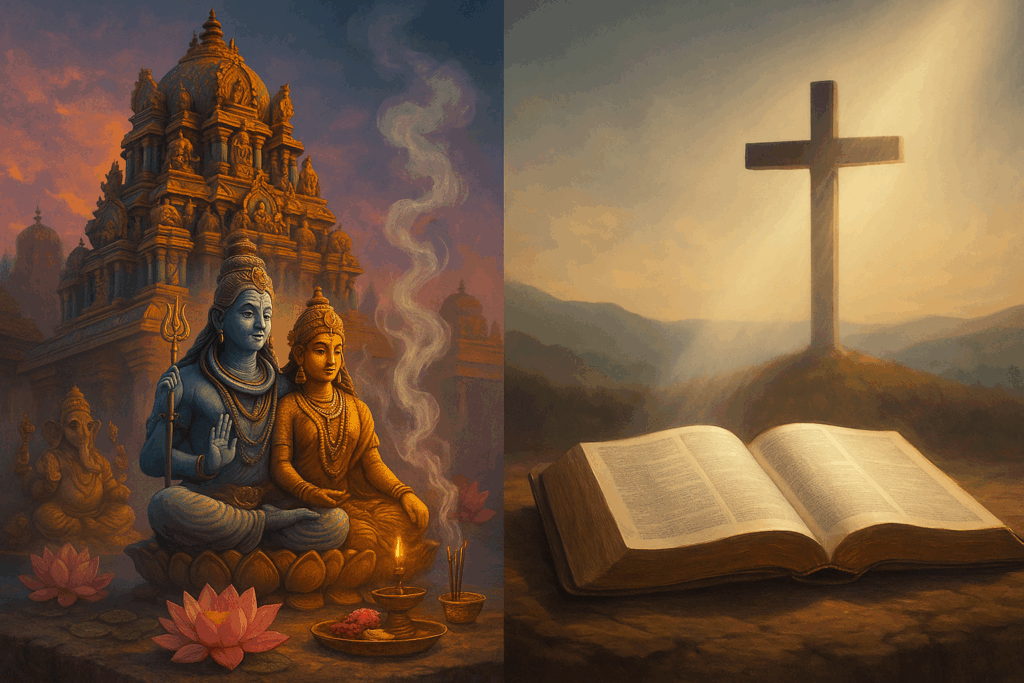
Key Beliefs, Differences, and What It Means for Faith
Comparing two major world religions can be meaningful for anyone seeking clarity about spiritual truth, purpose, and the nature of God. Hinduism and Christianity both have rich histories and deeply held beliefs, but their core teachings and views of salvation, God, and human purpose differ significantly.
This page explains the central differences between Hinduism and Christianity in a respectful and educational way. It also highlights how each religion answers some of the most fundamental questions of life: Who is God? What does it mean to be saved? How should we live? Understanding these differences can help you pursue truth with both faith and reason.
Overview — What Is Hinduism?
Hinduism is one of the world’s oldest religions, with diverse beliefs and practices. It is not founded by a single teacher, and its sacred writings include texts like the Vedas, Upanishads, Bhagavad Gita, and various scriptures from different traditions.
Core features of Hindu belief include:
- Polytheism and many manifestations of the divine
Hinduism often teaches that there are many gods or aspects of the divine. Some traditions see all of reality as ultimately one divine essence expressed in different forms. - Reincarnation and karma
Most Hindu traditions teach that the soul is reborn into different lives based on one’s actions (karma). The cycle of birth, death, and rebirth (samsara) continues until ultimate liberation (moksha) is achieved. - Pathways to truth
Hindu teachers describe various spiritual paths — such as devotion (bhakti), knowledge (jnana), and disciplined action (karma yoga) — that lead toward spiritual realization.
These beliefs shape how followers view life, duty, and spiritual liberation.
Overview — What Is Christianity?
Christianity is centered on the life and teachings of Jesus Christ and is rooted in the belief that God reveals Himself through Scripture.
Key Christian beliefs include:
- One living God
Christianity teaches that there is one God who exists eternally in three Persons — Father, Son (Jesus Christ), and Holy Spirit — known as the Trinity. - Jesus Christ as Savior
Christians believe Jesus is God incarnate, who lived, died, and rose again to offer forgiveness and eternal life to all who trust in Him. - Salvation by grace through faith
Rather than being earned by actions, Christianity teaches that salvation is a gift of God’s grace received through faith in Christ. - Scripture as authoritative revelation
The Bible, consisting of the Old and New Testaments, is considered God’s Word and the primary guide for faith and practice.
These beliefs form the basis of Christian life, worship, and understanding of God’s purpose for humanity.
Key Differences Between Hinduism and Christianity
Below are some of the most significant differences from a theological and worldview perspective:
View of God
Hinduism:
In many Hindu traditions, the divine is understood as one reality expressed in multiple forms, or as many gods representing aspects of the ultimate divine principle.
Christianity:
Christianity teaches one personal God who relates to humanity, not an impersonal force. The Christian God desires relationship with individuals.
Salvation and Eternal Life
Hinduism:
Salvation (moksha) is liberation from the cycle of rebirth and is achieved through spiritual practices, knowledge, or dharma (right living).
Christianity:
Salvation is a gift received by faith in Jesus Christ. Eternal life is a personal relationship with God, not a release from cycles of rebirth.
View of Jesus
Hinduism:
Views on Jesus vary widely within Hindu thought — from seeing him as a great teacher or holy person to viewing him as one of many divine figures.
Christianity:
Jesus is central — fully God and fully human, whose death and resurrection provide forgiveness and reconciliation with God.
Human Purpose
Hinduism:
Human purpose often involves attaining spiritual liberation, understanding one’s true self, and living in harmony with cosmic law (dharma).
Christianity:
Human purpose is to know God, follow Christ, and live out God’s calling in daily life through love, obedience, and service.
A Practical Analogy — Two Rivers with Different Destinations
Imagine two rivers flowing through the land:
- One river flows in cycles, feeding lakes and branching back into smaller streams before returning to its source again and again — never reaching the ocean, but continually circling.
- The other river flows steadily toward the ocean, carrying all who enter it in one direction with a clear destination in sight.
In this analogy:
- Hinduism’s view of life, karma, and reincarnation resembles the river that moves through cycles — return, rebirth, and eventual release through spiritual effort.
- Christianity’s view of life and salvation focuses on a relationship with Jesus Christ — moving toward a purposeful, personal destination beyond life as we know it.
This analogy is not meant to diminish spiritual pursuit in any tradition but to help readers grasp direction and purpose differences between the two worldviews.
Why These Differences Matter
Understanding these differences is not merely academic. They shape how people:
- View suffering and purpose
- Understand the meaning of life
- Relate to God or the divine
- See the afterlife and hope
- Shape moral and ethical choices
For someone exploring spiritual truth, comparing core beliefs helps clarify what each religion teaches about life’s greatest questions.
Common Questions People Ask
Q: Can someone blend both religions?
A: Many try, but the foundational beliefs of each tradition differ in fundamental ways about God, salvation, and authority. Blending possible practices doesn’t resolve deeper theological contradictions.
Q: Is one religion “right”?
A: This page aims to explain differences clearly. Whether one path is right depends on personal spiritual conviction. Christianity invites people to explore Scripture and the life of Jesus with honesty and inquiry.
Q: How can I explore this further?
A: Reading the Bible and learning more about Christian teaching helps you evaluate truth claims fairly and respectfully.
How to Study This Topic with Scripture
If you want to explore this topic deeply, consider:
Comparing texts about God’s nature (e.g., Genesis 1; John 1; Psalm 139)
Reading about Jesus’ identity and mission (e.g., John 14; Philippians 2; Hebrews 1)
Studying passages about salvation and grace (e.g., Ephesians 2; Romans 6–8)
For structured guidance, see our Bible Study Plans page.
Respect, Curiosity, and Truth
When comparing religions, respect for people is essential even when beliefs differ. This page is designed to help readers understand differences without resorting to disrespect or harsh language. Genuine curiosity and honest investigation often lead to deeper insight — regardless of your faith journey. I encourage you to investigate for yourself and find the truth, because there can only be one truth. Neither blindly follow tradition nor get convinced by an eloquent speaker or writer.
I was born into a Hindu family. Hinduism was all I knew growing up. I revered the innumerable idols, participated in annual rituals, listened to the temple priest’s prayers which I never understood, and observed festivals because it was fun. My faith was sincere. But over time, I began to ask deeper questions: “Why am I doing this?”, “Who is truly listening?”, “What happens after I die?”, and “Can I ever be free from guilt and fear?”
I have lied, cheated, lusted, stolen, and cursed. Which one of the hundreds of gods is going to forgive me? And will I ever know if I’ve actually been forgiven? What guarantee is there that I will get to heaven after I die? And if there is no heaven or hell, and if this life is all there is, then what is the point of seeking after any god?
These questions eventually led me on a spiritual journey—one that opened my eyes to profound differences between Hinduism and Christianity. This page is not here to mock or insult anyone’s belief system, but to gently offer insights that may help seekers like I once was to explore truth with honesty and courage. If heaven and hell are real, and if God is real, then we just get ONE CHANCE to get it right. So does it not make sense to ask questions and seek out the truth before it is too late?
Hinduism – A Rich Cultural and Moral System
Without going in to too much detail, I came to learn that Hinduism is not a single unified religion, but rather a collection of diverse beliefs, scriptures, and practices. It offers thousands of deities, each representing certain traits or powers. Some teach peace, others revenge. Some are protectors, while others destroy. There are many beautiful teachings within Hindu philosophy that promote moral living, non-violence, truth, self-discipline, and respect for life. The philosophical teachings are perhaps good.
But here are some important questions I began to ask myself: Does Hinduism offer forgiveness? Does it offer a personal Savior because I know for sure I can’t qualify on my own? Does it provide 100% assurance for me of salvation and eternal life in heaven? Is it even possible to have a personal RELATIONSHIP with god? If yes, then which god?
The honest answer is: no. Hinduism, at its core, teaches karma—the idea that your actions determine your destiny. Good deeds bring good results, and bad deeds bring consequences either in this life or the next or both. The cycle of birth, death, and rebirth (reincarnation) continues until you reach moksha (liberation). Since no man is perfectly sinless, then this would imply that there is no heaven to gain or hell to lose. We will all be in a perpetual cycle of birth and rebirth. So then why seek after gods?
While karma encourages moral living, it also creates a crushing burden: What if I fail? What if I do wrong unintentionally? How much karma is enough to break free? How and when can I know if my good deeds outweigh my bad deeds? There is no clear answer. There is no assurance. There is no Savior to carry your burden. Therefore we end up living life accepting situations and circumstances as our “fate”, and “hoping” we have done well enough to gain salvation. And we do not have the courage to give up on the gods, because we are fearful due to lack of a personal relationship with god. What if something bad happens?
Christianity – A God Who Came to Rescue
Christianity presents a radically different message. Christianity, first and foremost is not a religion. It offers a RELATIONSHIP with the one true God. Yes, it is possible to REALLY KNOW Him and walk in intimacy with Him daily. It teaches that salvation is not something we can earn—it’s something we receive as a gift. It is impossible for sinful man to earn salvation with good works. No amount of good works can cover for our sinful hearts. Only a sinless savior willing to pay the price for our sins can rescue us. At the heart of Christianity is grace. Grace is the unearned favor of God.
We are all flawed. We’ve all sinned and we still do. No one can perfectly follow all moral codes. This is because of mankind’s sinful heart. The Bible says: “All have sinned and fall short of the glory of God” (Romans 3:23).
In the beginning, God created a perfect world and a perfect man and woman. We enjoyed perfect intimacy with God. We had the freedom of choice and man chose to sin. We thereby got separated from the very source of eternal life, and death entered the world. This is why there is such grief when a loved one passes away. Death was not meant to be. We were made to stay connected to our life source and live forever. But here is the beauty: God didn’t leave us stuck. He sent His Son, Jesus Christ, to rescue us.
Jesus came not to demand perfection, but to offer forgiveness. He lived a sinless life, died on the cross to pay the penalty for our sins, and rose again from the dead to prove that the price was paid and we could all have eternal life through faith in Him. In Jesus, we are not bound by karma or endless rebirths. We are given a new life, a clean slate, and the assurance of eternal life.
Christianity teaches: “If anyone is in Christ, he is a new creation” (2 Corinthians 5:17).
This is why you will find the majority of “true” Christians to be loving, kind, gentle, very charitable and generous. Yes, there are fake one’s as you will find in any religion and they bring shame to the name they bear. But personally, I found an assurance, a guarantee of forgiveness, and a guarantee of salvation and eternal life in following Christianity as opposed to Hinduism. I found answers to all my burning questions in Christianity.
And not to mention, every Christian has access to God’s Word, The Holy Bible. We can read God’s Word for ourselves and not have to depend on rituals or priests or offerings to have our prayers answered. We can pray and speak to God directly and have a very personal relationship with Him. In contrast, when I was a Hindu, I “heard” of Bhagvad Gita, but have never seen one nor had access to one. And I submit to you, the vast majority of Hindu’s today do not have a copy in their homes too. I simply followed tradition handed down from my great grandparents to my grandparents to my parents. I am sure that tradition goes way back to several thousands of years.
But tradition is not equal to truth. Like I said earlier, we all have JUST ONE CHANCE to get this right. I encourage you to take a moment to think about life after your death, be courageous to ask those tough questions like I did, do your research, seek after the truth and then make your decision.
A Call to Think Deeply
If you are a Hindu reading this, please know: I am not here to criticize your beliefs. I was once like you and I completely understand the beauty and culture that surrounds Hindu traditions. But I also want to lovingly invite you to ask: Do I have peace with God? Can I know Him personally? Can I be truly forgiven?
Jesus offers what no ritual, idol, or religious practice can: a relationship with the living God, not based on your merit, but on His mercy. Jesus Christ took your punishment, so you could receive His righteousness. He died your death so you could live His life.
You don’t need to abandon everything you’ve ever known. You just need to come as you are—with your questions, doubts, and hunger for truth. You just need to pray an honest prayer in the lines of something like this, but use your own words.
Dear God, if you are real, make yourself known to me. I really WANT to know you. Who are you? I want to be reconciled to you. I know I am sinful and need forgiveness. I want to have a clean start and I want to start living for you. But I want to know you. Please speak to me and reveal the truth to me.
Jesus said, “I am the way, the truth, and the life. No one comes to the Father except through me.” (John 14:6) . He will show you the way.
If you’re ready to begin a new journey, I encourage you to start by reading the Gospel of John in the Bible. Pray and ask Jesus to reveal Himself to you. Here are some Bible Study Tools to help you start.
Hinduism vs Christianity is not just a comparison of religions. It is a question of eternal significance. One system says, “Work harder to reach God.” The other says, “God came down to reach you.”
Let your heart be open. The truth will never fear questioning. And you might just discover, like I did, that truth has a name—Jesus.